Google Introduces AI Performance Reporting and AI Content Controls in Search Console
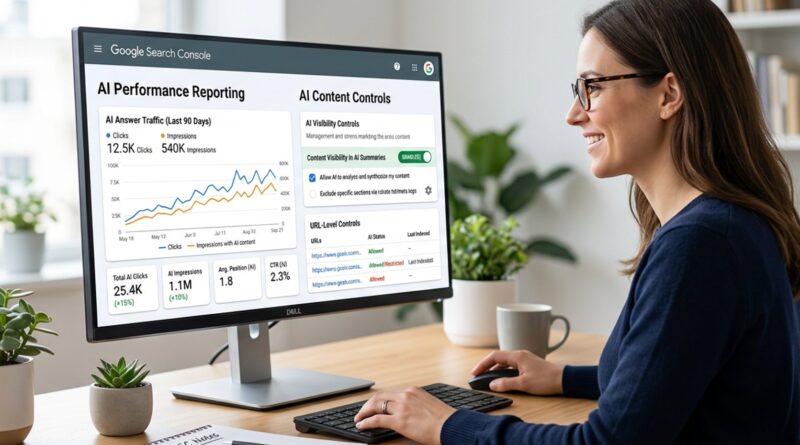
Google has taken another significant step in the evolution of AI-powered search by introducing dedicated AI performance reporting in Google Search Console and testing new controls that allow publishers to manage how their content appears in AI-generated search experiences. These updates are currently rolling out to a subset of website owners in the UK and are expected to expand more broadly over time.
Why This Matters
Over the past two years, AI Overviews and AI Mode have transformed how users interact with search results. Instead of clicking through multiple websites, users increasingly receive synthesized answers directly within Google’s search experience.
For publishers, marketers, and SEO professionals, one of the biggest challenges has been the lack of visibility into how their content performs inside these AI-generated experiences. Until now, measuring AI search visibility required relying on third-party tools and indirect estimates.
Google’s latest announcement addresses that gap.
What Is New?
1. Dedicated AI Performance Reporting
Google is introducing new Search Generative AI reports within Search Console that provide website owners with dedicated visibility into impressions generated from AI-powered search features such as AI Overviews and AI Mode.
This gives SEO teams a clearer understanding of:
- How often their content appears in AI-generated responses
- Which pages are being surfaced within AI experiences
- Overall visibility trends across generative search
As AI search becomes a larger percentage of search activity, these metrics will become increasingly important alongside traditional rankings, clicks, and impressions.
2. New AI Content Control Toggle
Google is also testing a new Search Console control that allows publishers to prevent their content from appearing in AI-generated responses while maintaining visibility in traditional organic search results.
Historically, publishers faced a difficult choice:
- Allow content to be used in AI-generated experiences
- Or block AI usage and potentially lose search visibility
The new approach separates those decisions, giving publishers more granular control over how their content is utilized within Google’s AI ecosystem.
The Growing Publisher Debate
These changes arrive amid increasing concerns from publishers regarding the impact of AI-generated answers on website traffic.
Several studies and industry reports suggest that AI-generated search experiences may reduce clicks to publisher websites as users receive answers directly on the search results page. Research published in 2026 found measurable declines in traffic for certain informational content categories after AI Overview adoption.
At the same time, Google argues that AI-powered search creates new discovery opportunities and can surface authoritative content in ways that traditional search rankings may not.
The introduction of reporting and control mechanisms appears to be Google’s attempt to improve transparency and give publishers greater flexibility.
What This Means for SEO Teams
SEO success is no longer limited to ranking positions.
Organizations should now begin tracking three distinct visibility layers:
Traditional Search Visibility
- Rankings
- Organic clicks
- Search impressions
AI Search Visibility
- AI Overview appearances
- AI Mode citations
- AI-generated impressions
Brand Presence in AI Answers
- Mentions
- Citations
- Referral traffic from AI experiences
The emergence of dedicated AI reporting signals that AI visibility is becoming a first-class SEO metric rather than an experimental consideration.
Key Takeaways
Google’s latest Search Console updates represent one of the most important developments in search measurement since the introduction of AI-powered search experiences.
The new capabilities provide:
- Better visibility into AI search performance
- More transparency around AI-generated search experiences
- Greater publisher control over AI content usage
- A new framework for measuring SEO success beyond traditional rankings
As search continues shifting from “ten blue links” toward answer-driven experiences, marketers and publishers will need to monitor not only where they rank, but also how often they are cited, referenced, and surfaced by AI systems.
The future of SEO is increasingly becoming a combination of search visibility, AI visibility, and content authority. Google’s latest Search Console updates are the clearest indication yet that this future has already arrived.